

AERONAUTICAL ENGLISH — FOR GROUND HANDLING AND AIR CARGO OPERATORS
On the ramp and in the cargo terminal, precise communication isn't a soft skill — it's an operational safety requirement.
The Language of Safe and Efficient Ground Operations
Ground handling and air cargo operations involve constant, high-stakes communication.
Communication between ramp crews and flight deck, between cargo operators and customs, between handling agents and the operations centre. When that communication breaks down, delays, errors, and safety incidents follow.
IITA's Aeronautical English programme for ground handling and air cargo operators is built around the specific communication demands of your role. It develops the ICAO-aligned English skills and operational vocabulary that make you a more effective, safer, and more employable aviation professional.
With an optional placement at a European air base, this programme offers a unique opportunity to gain real-world sector experience and launch a solid career.

The programme is suitable for operational staff at any level — from newly appointed ground handling assistants to experienced supervisors working in multi-national operational environments.
✈️ ICAO-standard phraseology and terminology
✈️ Cargo and ground operations communications
✈️ Dangerous goods and safety procedures language
Lorem Ipsum Dolor Sit
54%
Duis Aute Irure Dolor
80%
Excepteur sint Occaecat
38%
Why Aeronautical English Matters in Ground Operations
In a multi-national, multi-operator airport environment, the ability to communicate clearly in ICAO-standard English is a competitive advantage — and in many roles, a contractual requirement.
The operational vocabulary of ground handling and air cargo is specific and precise. Standard communications must be understood correctly — by your team, by the flight crew, by customs, and by partner handling agents whose operational language is English.
This programme develops competence across the key communication scenarios of your role:
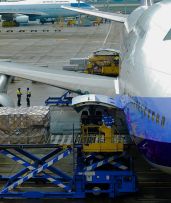
✈️ Ramp communications — ground-to-flight deck, marshalling, turnaround coordination
✈️ Cargo documentation — AWB language, cargo manifests, customs declarations
✈️ Dangerous goods procedures — IATA DGR notification and communication requirements
✈️ Incident and delay reporting — clear, structured English for operational reports
✈️ Inter-agency coordination — communication with customs, security, catering, and fuel suppliers
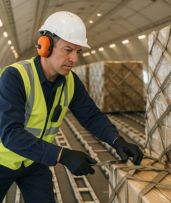
Loadmasters work across a wide range of aviation operations:
✈️ Air cargo companies – Handling of valuable or dangerous goods (eg, DHL Adviation, FedEx)
✈️ Commercial airlines – Cargo and baggage management (eg, TAP Air Cargo, Luthansa Cargo)
✈️ Military forces – Coordination of military equipment transport, tactical airdrops, and humanitarian airlifts
✈️ Humanitarian organisations — Transport of essential supplies for disaster relief and emergency operations worldwide
The IITA Aeronautical English for Ground Handling and Air Cargo Operator Programme gives ground handling and air cargo professionals the ICAO-aligned communication skills needed to operate safely, efficiently, and confidently in international aviation environments.
Frequently Asked Questions (FAQs)
Over
100
aviation professionals trained by IITA
ICAO-Aligned | Phraseology and communications standards
All levels | From CEFR B1 to professional fluency
The IITA Air Cargo Operations Course teaches you all the essential skills to perform this role safely and efficiently, preparing you for a constantly growing global job market.
Frequently Asked Questions (FAQs)
Why train with IITA?
Progress is assessed through scenario-based exercises that mirror the real communications challenges of your operational role.
All language content is drawn from real ground handling and cargo scenarios — not generic business English or abstract grammar exercises.

Completing this programme gives you a demonstrable English proficiency credential that is specifically relevant to aviation employers across the industry.

The programme is developed in alignment with ICAO Language Proficiency Requirements and ground operations communication standards.
Precise Communication. Safer Operations. Better Career Prospects.
Develop the English skills that the ground handling and air cargo sector actually demands.
TheGem provides custom AI-powered solutions that automate workflows, unlock predictive insights, and create a competitive advantage.
Where can I work?
Frequently Asked Questions (FAQs)
A minimum of CEFR Level B1 (intermediate) is recommended. Contact us if you are unsure of your current level — we can advise on the most appropriate starting point.
No. This is an operationally specific programme built around the communication demands of ground handling and air cargo roles. General English proficiency is developed through aviation-specific content and scenarios.
The programme develops the skills relevant to ICAO Language Proficiency Requirements. Whether specific formal ICAO LPR assessment is required depends on your role — contact us for guidance.
Duration and scheduling are confirmed at pre-registration. Contact us for current cohort details.
Click PRE-REGISTER at the top of this page and complete the short form.
Interested? Get in Touch

Bespoke Aviation Training
We design industry-ready programmes
tailored specifically for you.
tailored specifically for you.
